Tomato is one of the most widely grown
vegetable crops in Andhra Pradesh. Major
growing districts include Chittoor, Kurnool,
Kadapa, Ananthapur and Krishna.
Tomato is a high-value crop — but it is
also highly sensitive to irregular watering.
Uneven water supply causes blossom drop,
fruit cracking and blossom end rot —
reducing both yield and market value.
Drip irrigation is the most effective
solution for tomato farmers in AP —
delivering consistent, precise water
directly to the root zone throughout
the growing season.
In this complete guide we explain
everything you need to know about
drip irrigation for tomato farming
in Andhra Pradesh.
Why Tomato Farmers in AP Need
Drip Irrigation
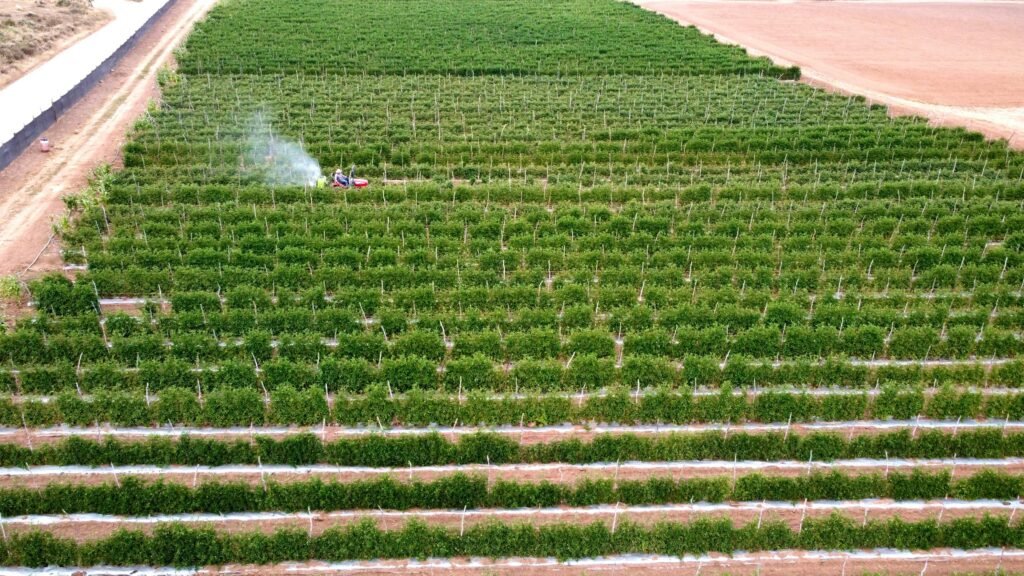
Tomato requires consistent and uniform
moisture throughout its growth cycle.
Any irregular watering causes serious
problems:
- Blossom end rot — caused by
irregular calcium uptake due to
inconsistent watering - Fruit cracking — caused by sudden
heavy watering after dry period - Blossom drop — caused by water
stress during flowering - Fungal diseases — caused by
wet foliage from overhead
or flood irrigation - Poor fruit quality — uneven
sizing reduces market price
Drip irrigation solves all these
problems by delivering water slowly,
steadily and directly to tomato
roots — keeping moisture levels
perfectly consistent throughout
the season.
Benefits of Drip Irrigation for Tomato Farming
Tomato farmers across Chittoor, Kurnool
and Kadapa who use drip irrigation
report these benefits:
✅ Water Saving: Save 55–65% water
compared to flood irrigation
✅ Higher Yield: 30–50% increase
in tomato yield per acre
✅ Better Quality: Uniform moisture
produces uniform fruit size —
better market price and less
rejection
✅ Less Disease: Dry foliage reduces
fungal diseases like early blight,
late blight and leaf curl virus
✅ No Fruit Cracking: Consistent
moisture prevents sudden water
stress that causes fruit cracking
✅ Fertigation: Apply fertilizers
through drip — saves 35–40%
on fertilizer costs
✅ Less Weeds: Dry inter-row spaces
reduce weed growth significantly
✅ Lower Labour: Saves ₹5,000–8,000
per acre per season on irrigation
and weeding labour
✅ Early Harvest: Consistent moisture
and nutrition leads to uniform
ripening and earlier harvest
Which Drip Irrigation Pipe is Best
for Tomato Farming?
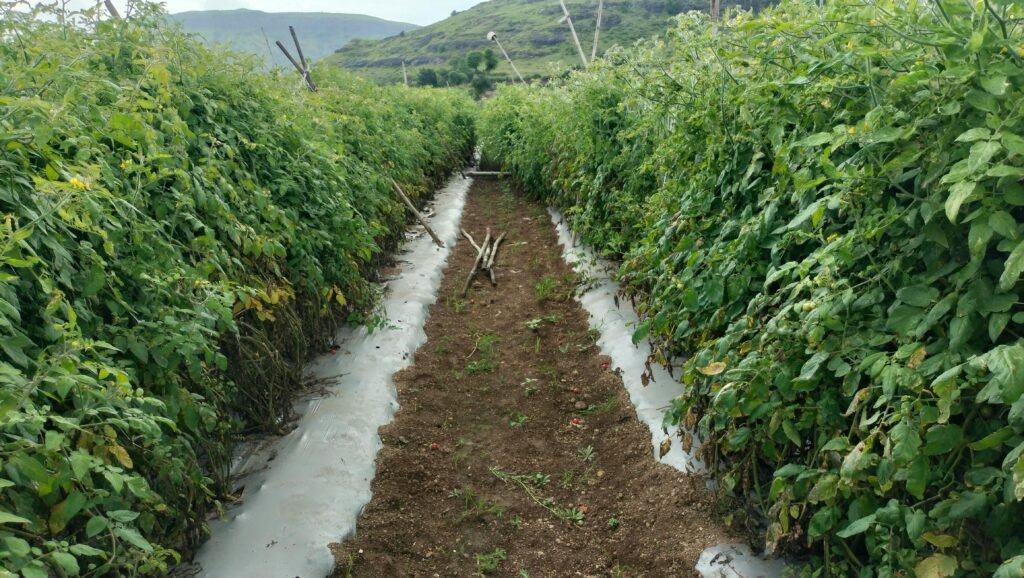
For tomato farming in Andhra Pradesh
the best choice is Inline Drip
Irrigation Pipe.
Why inline drip pipe for tomato:
- Tomato is a long duration crop
(4–6 months) — inline pipe
lasts much longer than flat tape - Emitters are built inside the
pipe — protected from UV and
physical damage - Very uniform water distribution —
essential for consistent
tomato quality - Suitable for staked tomato
cultivation common in AP - Can be reused for 5–8 seasons
with proper care
Recommended specifications
for tomato:
Size: 16mm inline drip pipe
Emitter spacing: 30cm or 45cm
Discharge: 2 LPH or 4 LPH
Lateral spacing: As per your
plant spacing (60cm or 90cm rows)
For very small farms or seasonal
tomato: Drip Flat Tape 16mm with
0.4mm thickness is a cost-effective
alternative.
How to Install Drip Irrigation
for Tomato — Step by Step
Step 1 — Plan Your Layout
Measure your field size and row
spacing before buying materials.
Call Ramanaiah Industries on
9440732519 for a free customised
layout plan for your tomato field.
Step 2 — Install Filter Unit
Install a sand filter and screen
filter at the water source.
Tomato drip systems must have
a good filter — clogged emitters
cause dry patches and uneven
fruit development.
Step 3 — Lay Main HDPE Pipeline
Lay the main HDPE pipeline from
your borewell or water source
along the main axis of your field.
Step 4 — Lay Sub Main Pipeline
Connect sub-main HDPE pipes
perpendicular to the main line
along the field length.
Step 5 — Connect Inline Drip Laterals
Connect inline drip pipes along
each tomato row. One lateral per
row for single row planting.
One lateral between two rows
for double row planting.
Step 6 — Install Fertigation Unit
Install a venturi injector or
fertilizer tank for fertigation.
This is highly recommended for
tomato — proper nutrition through
fertigation increases yield
by 40–50%.
Step 7 — Test System Before Planting
Run the system and verify all
emitters are working before
transplanting tomato seedlings.
Check for leaks at all joints.
Step 8 — Mulching (Recommended)
After laying drip laterals apply
plastic mulch over the beds.
Mulching + drip irrigation together
gives best results for tomato in AP.
Water Schedule for Tomato with Drip Irrigation in AP
Recommended water schedule for
tomato with drip irrigation in
AP conditions:
| Crop Stage | Duration | Frequency |
|---|---|---|
| After transplanting | 15 min | Twice daily |
| Establishment stage | 20 min | Twice daily |
| Vegetative stage | 30 min | Once daily |
| Flowering stage | 40 min | Once daily |
| Fruit setting stage | 45 min | Once daily |
| Fruit development | 45 min | Once daily |
| Ripening stage | 20 min | Once daily |
Very important for tomato:
- Never let soil dry out completely
during fruit development — causes
blossom end rot and fruit cracking - Reduce watering 7–10 days before
harvest to improve fruit firmness
and shelf life - Increase watering during summer
months — AP summers are harsh
and tomato needs more water
Adjust timing based on your
soil type and weather conditions.
Fertigation Schedule for Tomato Using Drip System
Fertigation is one of the biggest
advantages of drip irrigation for
tomato. Applying fertilizers through
drip directly to roots increases
absorption by 40–50% compared to
broadcast application.
Recommended fertigation schedule
for tomato:
| Stage | Fertilizer | Qty/Acre |
|---|---|---|
| 0–15 days | 19:19:19 NPK | 3 kg |
| 15–30 days | Urea + MOP | 3+2 kg |
| 30–45 days | 13:0:45 NPK | 3 kg |
| Flowering | 0:52:34 NPK | 3 kg |
| Fruit setting | Calcium Nitrate | 3 kg |
| Fruit dev. | 13:0:45 NPK | 4 kg |
| Pre-harvest | MOP | 3 kg |
Always flush the drip system
with clean water for 10 minutes
after every fertigation session
to prevent emitter clogging.
Consult your local agriculture
officer for soil-specific
fertilizer recommendations.
Drip Irrigation + Plastic Mulch for Tomato in AP
The combination of drip irrigation
and plastic mulch is the most
successful technology for tomato
farming in Andhra Pradesh.
Benefits of drip + mulch together:
✅ Reduces soil moisture evaporation
by 70% — saves even more water
✅ Maintains soil temperature —
improves root activity
✅ Eliminates weeds completely —
zero weeding labour cost
✅ Prevents soil splash on fruits —
reduces soil-borne diseases
✅ Increases yield by additional
20–30% over drip alone
✅ Improves fruit quality and
shelf life
How to use:
- Lay inline drip pipe along rows
- Cover with black or silver
plastic mulch sheet - Make holes in mulch for
tomato transplanting - Transplant tomato seedlings
through mulch holes
This system is now widely used
by successful tomato farmers
across Chittoor and Kurnool
districts of AP.
Government Subsidy for Drip Irrigation on Tomato in AP
Tomato farmers in Andhra Pradesh
can get up to 90% subsidy on
drip irrigation under PMKSY scheme.
Subsidy amounts:
| Farmer Category | Subsidy | You Pay |
|---|---|---|
| Small & Marginal | 90% | 10% only |
| General Farmers | 75% | 25% only |
| SC / ST Farmers | 90% | 10% only |
| Women Farmers | 90% | 10% only |
For a 1 acre tomato drip system
costing ₹18,000:
Small farmer pays only ₹1,800!
Documents needed for subsidy:
- Aadhaar card
- Land documents (Patta/Adangal)
- Bank passbook
- Quotation from registered
manufacturer
Call Ramanaiah Industries on
9440732519 for a FREE quotation
for your subsidy application —
we will help you with the
entire process.
Cost of Drip Irrigation for Tomato per Acre in AP
Approximate cost of drip irrigation
for 1 acre of tomato in AP:
| Component | Cost |
|---|---|
| Inline drip pipe (16mm) | ₹6,000–9,000 |
| Main HDPE pipeline | ₹2,000–3,500 |
| Sub-main pipeline | ₹1,500–2,500 |
| Filter unit | ₹2,500–4,000 |
| Venturi injector | ₹1,500–2,500 |
| Connectors & fittings | ₹1,000–1,500 |
| Installation labour | ₹1,500–2,500 |
| ———————— | ———— |
| Total (approx.) | ₹16,000–25,500 |
After 90% government subsidy:
Small farmer pays only
₹1,600–2,550 per acre!
These are approximate prices.
Call us on 9440732519 for an
exact quotation for your
specific farm size.
Frequently Asked Questions — Drip Irrigation for Tomato in AP
Q: Is drip irrigation suitable for
both open field and greenhouse
tomato in AP?
A: Yes. Drip irrigation works
perfectly for both open field
tomato cultivation and greenhouse
tomato farming. For greenhouse
tomato we recommend inline drip
pipe with 30cm emitter spacing
for more precise water control.
Q: How many seasons can I reuse
inline drip pipe for tomato?
A: Good quality UV-stabilized
inline drip pipe from Ramanaiah
Industries lasts 5–8 seasons
with proper maintenance. Flush
the system after every season
and store the laterals properly
during off-season.
Q: Can drip irrigation prevent
blossom end rot in tomato?
A: Yes. Blossom end rot is mainly
caused by inconsistent calcium
uptake due to irregular watering.
Drip irrigation maintains
consistent soil moisture —
preventing blossom end rot.
Adding calcium nitrate through
fertigation further reduces
this problem.
Q: Which emitter spacing is best
for tomato — 30cm or 45cm?
A: 30cm emitter spacing is
recommended for tomato in sandy
and loamy soils of AP. In black
cotton soil 45cm spacing is
sufficient as water spreads
more laterally in heavy soils.
Q: Can I grow tomato in summer
with drip irrigation in AP?
A: Yes. Drip irrigation makes
summer tomato cultivation
much more feasible in AP.
The key is to irrigate in
early morning and evening —
avoid midday irrigation during
peak summer. Mulching with
drip further reduces heat
stress on tomato plants.
Q: Which districts in AP are
best for tomato farming
with drip irrigation?
A: Chittoor, Kurnool, Kadapa,
Ananthapur, Krishna and
West Godavari are major tomato
growing districts in AP.
Drip irrigation is most
beneficial in Rayalaseema
districts — Chittoor, Kurnool,
Kadapa and Ananthapur — where
water availability is limited.
Get Drip Irrigation Pipes for Your Tomato Farm
Ramanaiah Industries manufactures
high-quality inline drip pipes,
drip flat tapes and HDPE pipes
specifically suited for tomato
farming in Andhra Pradesh.
✅ BIS-certified quality pipes
✅ Factory-direct pricing —
no middlemen
✅ Free irrigation layout guidance
for your farm
✅ Free quotation for government
subsidy application
✅ Fast delivery across all
AP and Telangana districts
📞 Call / WhatsApp: 9440732519
📧 Email: info@ramanaiahindsturies.com
📍 Ananthapur, Andhra Pradesh
👉 View our Drip Flat Tape product
👉 View our HDPE Pipes product
👉 View our Inline Drip Pipe product
👉 View our Online Drip Pipe product
👉 Sprinkler Pipe:
👉 PVC Pipe:
👉 Drip Accessories:
👉 Contact Us:
👉 Call Now Button: